

This tour starts at the Denver airport. Please make sure you get there in plenty of time for your flight. Also, please note that the airline has a checked luggage fee, which you will need to pay.

| |||||||||||||||||||||||||||||||||||||||||||||||||||||||||||||||||||||||
 |
 |
(USA) 406 646 1118 x 12 • Email •
 Price
Price
$1671.00/person
for 8 to 14 people
;
$1756.00/person
for 6 to 7 people
;
$1894.00/person
for 5 people
;
$1947.00/person
for 4 people
;
$2249.00/person
for 3 people
; and
$2426.00/person
for 2 people
.
$3195.00 single guest
All prices are in US currency.
Highlights
Itinerary
Day 1 - Flight from Denver to Bozeman - About 2 hours
This tour starts at the Denver airport. Please make sure you get there in plenty of time for your flight. Also, please note that the airline has a checked luggage fee, which you will need to pay.
Day 1 - Bozeman airport to Big Sky - 41 mi / 65.97 km - About 50 minutes
One of our team will pick you at the airport, for the drive to West Yellowstone. The first part of the trip, to Big Sky, runs mainly alongside the Gallatin River, which has some spectacular white water rafting. With any luck, we may see bighorn sheep along the way.

Day 1 - Big Sky to West Yellowstone - About 55 minutes
The road from Big Sky to West Yellowstone sees us entering Yellowstone for the first time, although this part of Yellowstone is separated from most of the park by a small mountain range. There are also no thermal features here. This stretch does, however, give us the best chance of seeing moose, which you very rarely see in the main part of the park, for reasons your guide will explain to you.


You will be dropped off at your Yellowstone motel called Yellowstone Motel. You are then on your own for dinner, and to explore West Yellowstone.


Day 2
A sack lunch is provided today, which your guide will give you.
Day 2 - Yellowstone upper loop tour - About 8 hours
The route that the tour takes will depend on possible road closures in the park, as well as the time of year, but it will be something like the following.
There is going to be a lot to see and do. We'll head out of West Yellowstone towards Madison Junction, where the Firehole and Gibbon Rivers meet to form the Madison River. Turning left (north) we'll make for Norris Geyser Basin. Along the way we'll stop briefly at Gibbon Falls.
Although not as well known as the other geyser basins, Norris is the most thermally active part of Yellowstone. It is divided into two separate areas: Porcelain Basin and Back Basin. 


The next stop is Mammoth Hot Springs, headquarters of the park, and home to a fascinating array of weird rock shapes, bright colors and sizzling hot springs. Elk are generally plentiful in this area, wandering around the old park buildings, and, if you're lucky, you might even see a whole herd.
You can stroll through the ever changing terraces at Mammoth, admiring the travertine creations and hot springs. 


Leaving Mammoth we will travel towards Tower Roosevelt, which is where the road to the park's north east entrance, through the Lamar Valley, is. There is almost always wildlife to be seen in this area, even bears!


At Tower Junction we will branch off the main upper loop road, and head through the Lamar Valley, towards the north east entrance to Yellowstone. This is a particularly beautiful part of the park, and where the keen wolf watchers are generally to be found.


Everyone wants to see a bear in the wild at Yellowstone, and the trip from Tower Junction to Tower Falls is one of the best places to do so. The spring can be a great time to go looking for bears, as you have the opportunity of seeing mothers with their new born cubs. Tower Falls is an impressive water fall.


Assuming that it is open, the road from Tower Falls to Grand Canyon of the Yellowstone towers up into the sky as it crosses the Dunraven Pass at almost 9000 feet. We then drop down to Grand Canyon of the Yellowstone.
Grand Canyon of the Yellowstone is normally visited on our Lower Yellowstone Loop tour, and not this tour. Depending on the number of people on this tour who have not seen it, and how late it is, we may take the opportunity of checking out the area. The Yellowstone River has carved an impressive canyon through the rocks, over which two falls drop. The Lower Falls is over twice the size of Niagara Falls! It is in this area that you can catch a glimpse of the yellowish tinge to the rocks, from which the Yellowstone River got its name, but at a different location. We'll check out the canyon and falls from a number of different locations. You get so close to the Upper Falls that you almost feel like you can reach out and touch the thundering water. Don't! If there is time, other areas along the route that we may visit include Obsidian Cliff, Virginia Cascade and Undine Falls. After a long, fun-filled day, it is time to return to West Yellowstone. 


You are on your own for dinner, and to explore the town.
Day 3
A sack lunch is included today, which you can enjoy on the road.
Day 3 - Yellowstone lower loop tour - About 8 hours
The roads running through Yellowstone make up a massive figure of eight. The lower loop of the figure of eight comprises most of the thermal features that are to be seen in Yellowstone, including, of course, Old Faithful!
From West Yellowstone we'll follow the Madison River to Madison Junction. At Madison Junction we will turn right, or south, and travel along the Firehole River which runs through Yellowstone's thermal areas. The Firehole is famous amongst anglers for its pristine beauty and selection of brown, brook and rainbow trout. Depending on the time of the year, this area is often teeming with wildlife. With any luck you will see bison, elk, Trumpeter Swans and other animals and birds. A special treat in the spring is the baby bison calves. 


The first main thermal area we will be visiting is the Lower Geyser Basin, and Fountain Paint Pots. There is a boardwalk system running around and through the Fountain Paint Pots area, and it is a great place to go for a stroll, if the bison haven't got there first! Apart from the paint pots, there is also a selection of other thermal features in the area, including a number of geysers, one or other of which almost always seems to be erupting.


The next stop is the Midway Geyser Basin, home to Grand Prismatic Spring - one of the largest anywhere in the world - as well as Excelsior Geyser, now dormant, but discharging thousands of gallons of water every minute.


It is a short drive to the Upper Geyser Basin, home of Old Faithful, the world's best known and most reliable gusher. There is also so much more to the area than just Old Faithful. Old Faithful Inn, a wonderful old building - recently renovated - is located there - and a system of boardwalks will take you around the various other geysers in the area.


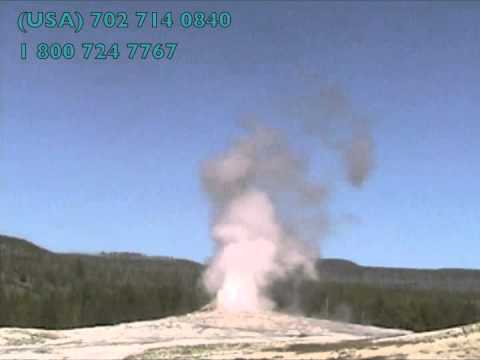
Old Faithful erupting!
The road from Old Faithful passes over the Continental Divide twice, on its way to West Thumb, a geyser basin right on the shores of the incredibly blue Yellowstone Lake.


Yellowstone Lake is off to the east as we make the trip up to Fishing Bridge. From there we head through the Hayden Valley, following the Yellowstone River, up to Grand Canyon of the Yellowstone. On the way we will pass Mud Volcano.
The Hayden Valley is known for its wildlife, particularly large herds of bison at certain times of the year. It is also an excellent location to look for grizzly bears, especially in the spring and early summer when they may be preying on newborn bison and elk cubs. 


The Grand Canyon of the Yellowstone is an unexpected treat amongst the thermal wonders. The Yellowstone River has carved an impressive canyon through the rocks, over which two falls drop. The Lower Falls is over twice the size of Niagara Falls! It is in this area that you can catch a glimpse of the yellowish tinge to the rocks, from which the Yellowstone River got its name, but at a different location. We'll check out the canyon and falls from a number of different locations. You get so close to the Upper Falls that you almost feel like you can reach out and touch the thundering water. Don't!


It is now time to go back to West Yellowstone.
Day 3 - West Yellowstone to Big Sky - About 55 minutes
After a fun filled day in the park, we'll head north out of West Yellowstone, keeping our eyes open for moose when we enter Yellowstone again.

Day 3 - Big Sky to Bozeman - About 49 minutes
Leaving Big Sky behind, we'll twist and turn our way through Gallatin Gateway on the way back to Bozeman.

Day 3 - Flight from Bozeman to Denver - About 1 hour 45 minutes
Your guide will drop you off at the Bozeman airport, for your flight back to the Denver airport, where the tour ends. Please note that the airline will have a checked luggage fee, which you will need to pay. Thanks for joining us!
Tour ID
1473
Please note the following...
This tour can be ordered online here. | |||||||||||||||||||||||||||||||||||||||||||||||||||||||||||||||||||||